Governance Intelligence Platform
Where governance becomes intelligence.
The Governance Intelligence Platform for boards, executives, risk, compliance, and audit — engines, command centres, and evidence-linked outputs on one model. ISO 27001-aligned security and governance practices.
ISO 27001-aligned
Security and governance practices for regulated environments
Evidence-linked governance
Assertions, controls, and decisions traceable to source
Role-based access
Persona command centres scoped to accountability
Audit-ready traceability
Governed object history on records and decisions
Risks
Controls
Incidents
Findings
Obligations
Evidence
Registers
Board packs
Reports
Governance is fragmented.
Risks, controls, evidence and decisions are often scattered across spreadsheets, systems and reports.
The platform
Registers record. Intelligence decides.
Aegis is the Governance Intelligence Platform for boards, executives, risk, compliance, and audit teams. It is not another register and not another dashboard.
Governance breaks when registers record activity but leadership cannot see pressure, lineage, or confidence. Aegis closes that gap with intelligence engines and persona command centres — so the same object model powers the boardroom and the control room.
How the model connects
Spreadsheets and registers capture what happened. They rarely explain what matters now. Aegis sits above your governed objects — risk, control, policy, obligation, incident, assertion, evidence, and decision — and produces intelligence each role can defend. The Governance Graph connects the model. Board Book and Decision Register complete the arc from record to committee-ready judgement.
Registers
Governed objects at the foundation
Risk, control, policy, obligation, and incident registers capture what exists — the raw material for intelligence, not the intelligence itself.
- Risk register
- Control register
- Incident register
- Policy library
Governance Operating System
One operating system for organisational governance.
An operating system is not a collection of modules. It is the layer that connects storage, computation, and interface — so each function does not rebuild lineage in Excel, email, and PowerPoint.
On one model, these surfaces work together:
Governance Graph
Connective tissue across policy, risk, control, and evidence
Intelligence Engines
Computation that reads governed objects
Board Book
Committee output composed from live intelligence
Decision Register
Formal judgement with traceable lineage
Assertions
Assurance claims linked to evidence
Evidence
Source artefacts tied to controls and decisions
Persona Command Centres
The right signal in each room
Select a layer to explore how governance connects end to end
Governance Graph Layer
Connective tissue across the organisation
The Governance Graph links policy, control, risk, obligation, evidence, incident, and decision — so leadership sees how assertions connect to source, not isolated register rows.
Entities
- Governance Graph
- Assertions
- Evidence links
Example signals
- 2,400 governed objects linked
- 18,000 relationships in the graph
- 94% assertions evidence-linked
Governance Graph Layer
Connective tissue across the organisation
The Governance Graph links policy, control, risk, obligation, evidence, incident, and decision — so leadership sees how assertions connect to source, not isolated register rows.
Entities
- Governance Graph
- Assertions
- Evidence links
Example signals
- 2,400 governed objects linked
- 18,000 relationships in the graph
- 94% assertions evidence-linked
Intelligence engines
Six engines. One intelligence model.
Governance Intelligence Engine
Health of the governance model — visible
Governance intelligence that shows where the model stalls
Reads policies, standards, attestations, and procedures. Surfaces health signals, maturity pressure, and governance bottlenecks — so leadership sees structural weakness before it becomes committee surprise.
Policies, standards, attestations → health signals & bottlenecks
Example intelligence signals
- 12 policy obligations overdue
- 3 governance bottlenecks
- Maturity pressure elevated in standards corpus
Governance graph
Every object connected. Every lineage visible.
Registers answer what exists. Governance answers how things affect each other. A policy without linked controls is rhetoric. A control without linked evidence is hope. A risk without linked incidents is hindsight.
A risk register alone cannot show that a policy gap caused a control failure that amplified an incident that triggered a board decision. Without graph semantics, teams rebuild that story manually — every quarter, in every pack.
Governance is a connected system.
Object types
- Risk
- Control
- Incident
- Finding
- Obligation
- Evidence
- Assertion
- Assurance
- Decision
- Board outcome
Selected object
Risk
Professional standards exposure
Enterprise risk linked to training compliance gaps and emerging incident signals — pressure visible before committee review.
9 relationships in highlighted subgraph
Connected relationships
- → mitigated by Training attestation control
- → amplified by Near-miss reporting gap
- ← confirms Near-miss reporting gap
- ← maps to Regulatory training obligation
Persona command centres
Command centres built for the room you are in.
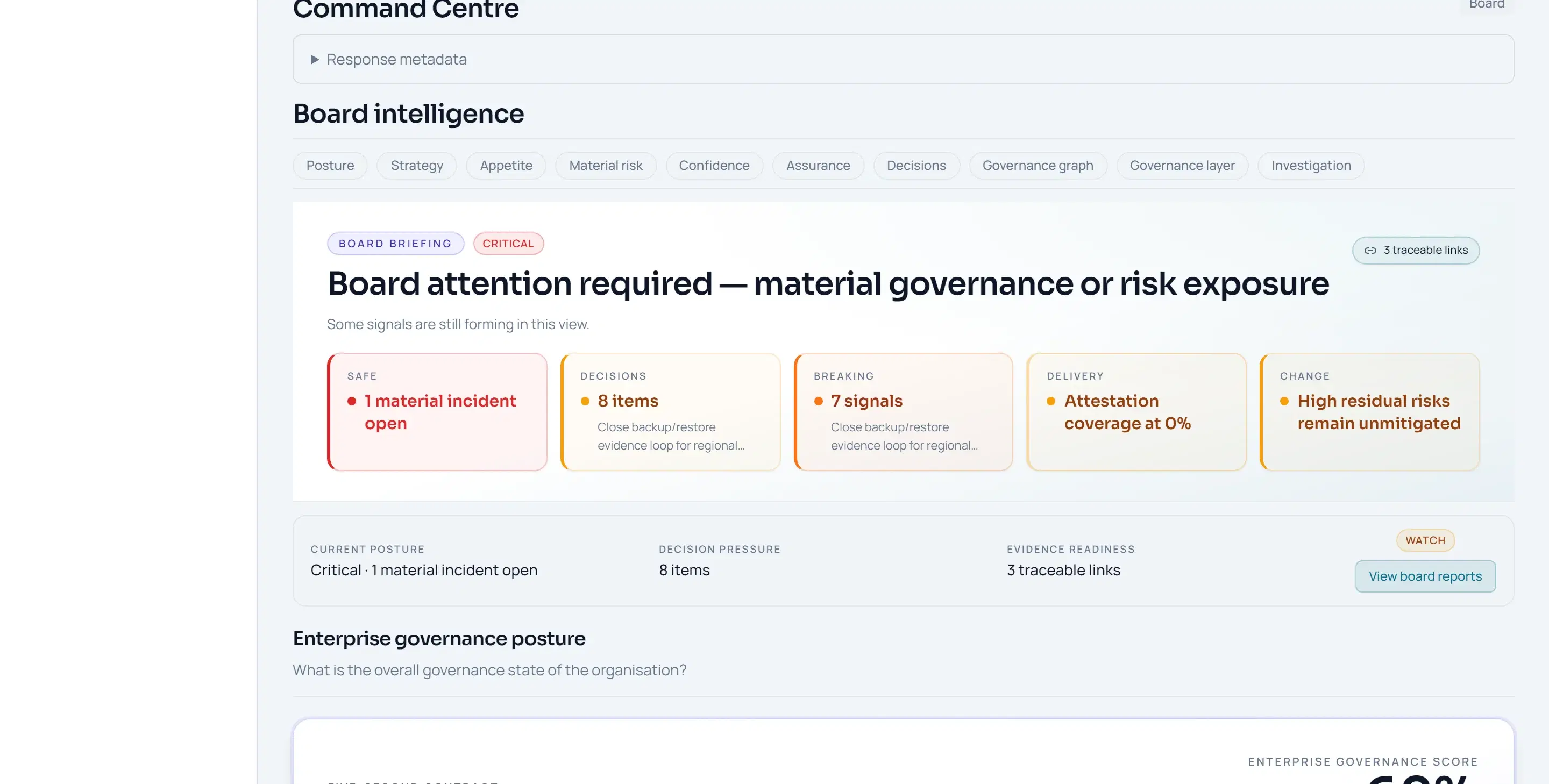
Board
Confidence for the boardroom — intelligence that shows where to probe, not where to read faster.
What they see
Governance posture, material risk, assurance confidence, board attention queue, strategic portfolio health, committee readiness, Board Book composition
Why it matters
Directors are liable for outcomes they cannot operationalise. They need a calibrated view of what requires challenge — not 200-page packs.
Value statement
Confidence for the boardroom — intelligence that shows where to probe, not where to read faster.
Command centre modules
- Governance posture
- Material risk
- Assurance confidence
- Board attention queue
- Strategic portfolio health
- Committee readiness
- Board Book composition
Fast onboarding
Start in Excel. Land in intelligence.
We can start where we are.
Aegis does not require governance maturity before adoption. Organisations start with existing registers and evolve into a Governance Intelligence Platform — import, connect, and activate intelligence in weeks, not years.
Today — disconnected artefacts
Excel
Aegis — connected intelligence
Stage outcome
Excel
Start where governance already lives. Your spreadsheet is not the enemy — isolation is.
Disconnected rows — no lineage to controls, evidence, or committee decisions.
Risk, control, and action registers living in workbooks — copied to SharePoint and debated in email.
Common adoption questions
“We only use Excel”
You do not replace Excel on day one. You import what works, govern it, and keep exporting only what you must — with lineage intact inside Aegis.
“Our data is messy”
Validation surfaces gaps before activation. Messy data in Excel becomes visible lineage in Aegis — not a hidden board risk.
“We already have SharePoint”
SharePoint stores files. Aegis governs relationships. Import registers from where they live today and connect them to engines, the graph, and command centres — so the board story inherits from the register, not another folder.
“Migration projects take too long”
Column mapping and validation are measured in days. Command centres open on activated registers — not after a year-long waterfall project plan.
Traditional governance vs Aegis
Deliver value in weeks, not years — without a waterfall implementation programme.
| Dimension | Traditional approach | Aegis |
|---|---|---|
| Time to first intelligence | Months of implementation | Weeks — upload to command centre |
| Governance model | Disconnected registers and slides | Connected Governance Graph |
| Reporting | Static quarterly packs | Live persona command centres |
| Lineage | Rebuilt manually each cycle | Traversable relationships on objects |
| Board readiness | PowerPoint assembled the night before | Board Book from governed intelligence |
- Day 1: Upload risk or control register from Excel
- Day 2–3: Map columns, validate lineage, resolve data gaps
- Day 4–5: Activate governed objects; Governance Graph begins connecting
- Week 2: First persona command centre live
- Week 3–4: Board Book and Decision Register on live intelligence
Timing illustrative — adjust per deployment scope in sales materials.
Integrations
Connects to the systems you already run.
Governance intelligence from every corner of the organisation.
Existing systems remain in place. Aegis becomes the governance intelligence layer above operational systems — connected, traceable, and visible to executives.
Identity
SSO and access governance aligned to persona command centres
Access governance must align to persona accountability. Identity providers authenticate users and scope persona command centres — ISO 27001-aligned practices without a parallel access database.
Governance outcome
SSO and role-based access aligned to persona command centres
Okta and Microsoft Entra ID
Example systems
Okta
Inbound signals
Enterprise SSO and identity governance
Microsoft Entra ID
Inbound signals
Directory and conditional access signals
The governance intelligence layer
Operational systems run the business. Aegis connects their signals into one governance model — so executives gain visibility across the enterprise without replacing the stack.
- Existing systems remain the system of record
- Governance intelligence sits above operational data
- Relationships become traceable across the organisation
- Persona command centres inherit connected signals
Connected governance
An incident in ITSM links to risk in the graph. A control failure in Aegis links to evidence in your document platform. A board metric in the warehouse inherits from governed objects — not manual ETL of slide tables.
Open integration
Inbound events and master data. Outbound metrics and evidence status. One governance model — not a replacement for ServiceNow, Okta, or Snowflake.
No new silos
Integrations attach to objects in the Governance Graph. The integration is an edge — not a parallel database.
Board outputs
Board Book and Decision Register — built from live intelligence.
Boards do not need more reports. Boards need confidence in decisions.
Committees are asked to approve, challenge, and record judgement — often on incomplete narrative assembled outside the system of record. Decision readiness means the board sees unresolved pressure, formal decisions, and evidence links before the meeting — not during it.
Evidence
Evidence artefacts tie assertions to source — so board discussion starts from proof, not narrative skill.
Evidence becomes visible and linked to governed objects before assurance is claimed.
Readiness indicators
- Evidence artefacts linked156
- Assertions awaiting evidence12
- Evidence coverage91%
Board Book preview
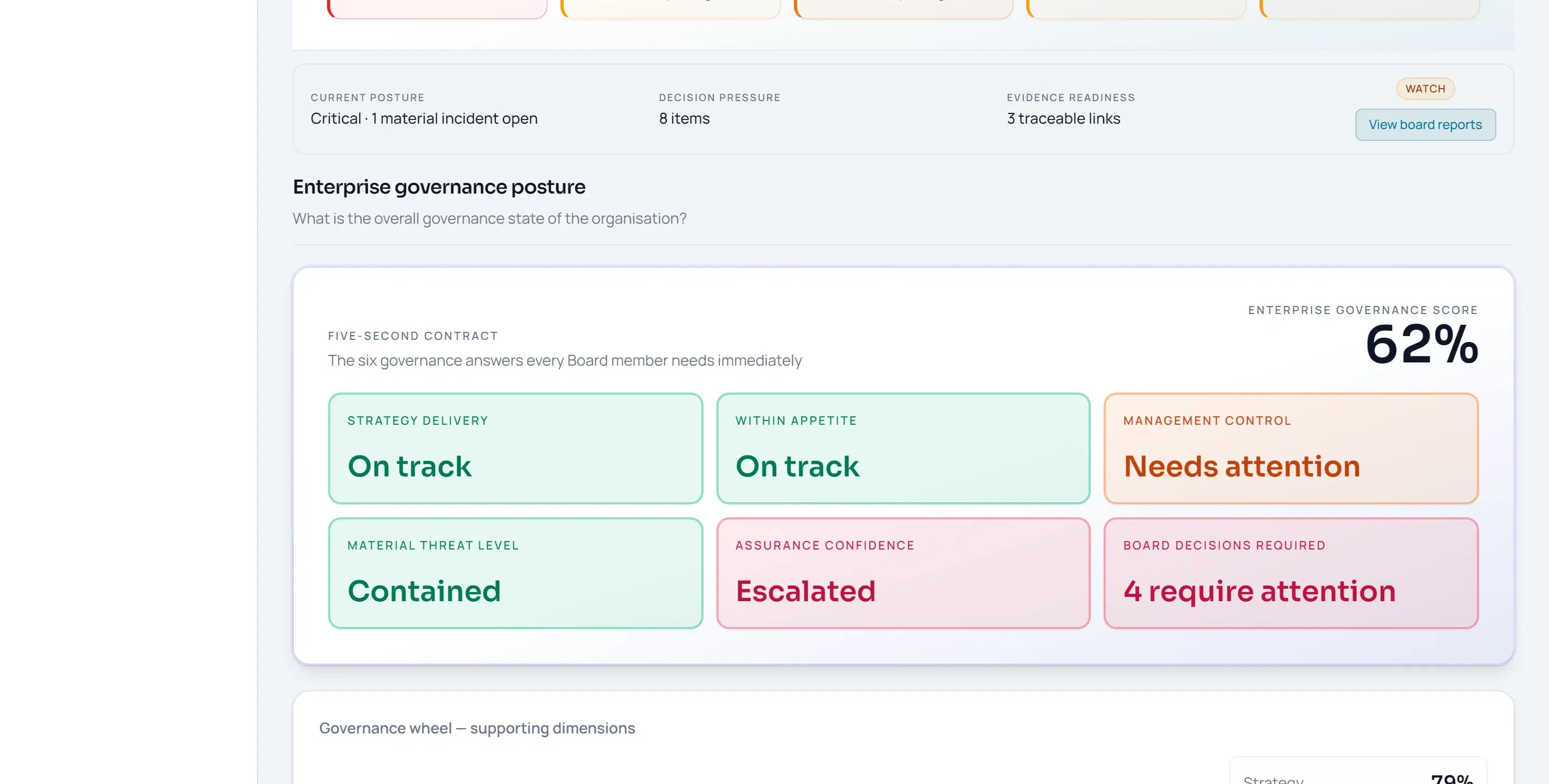
- · Agenda and governance posture
- · Material risk and appetite
- · Assurance and control confidence
Decision Register preview
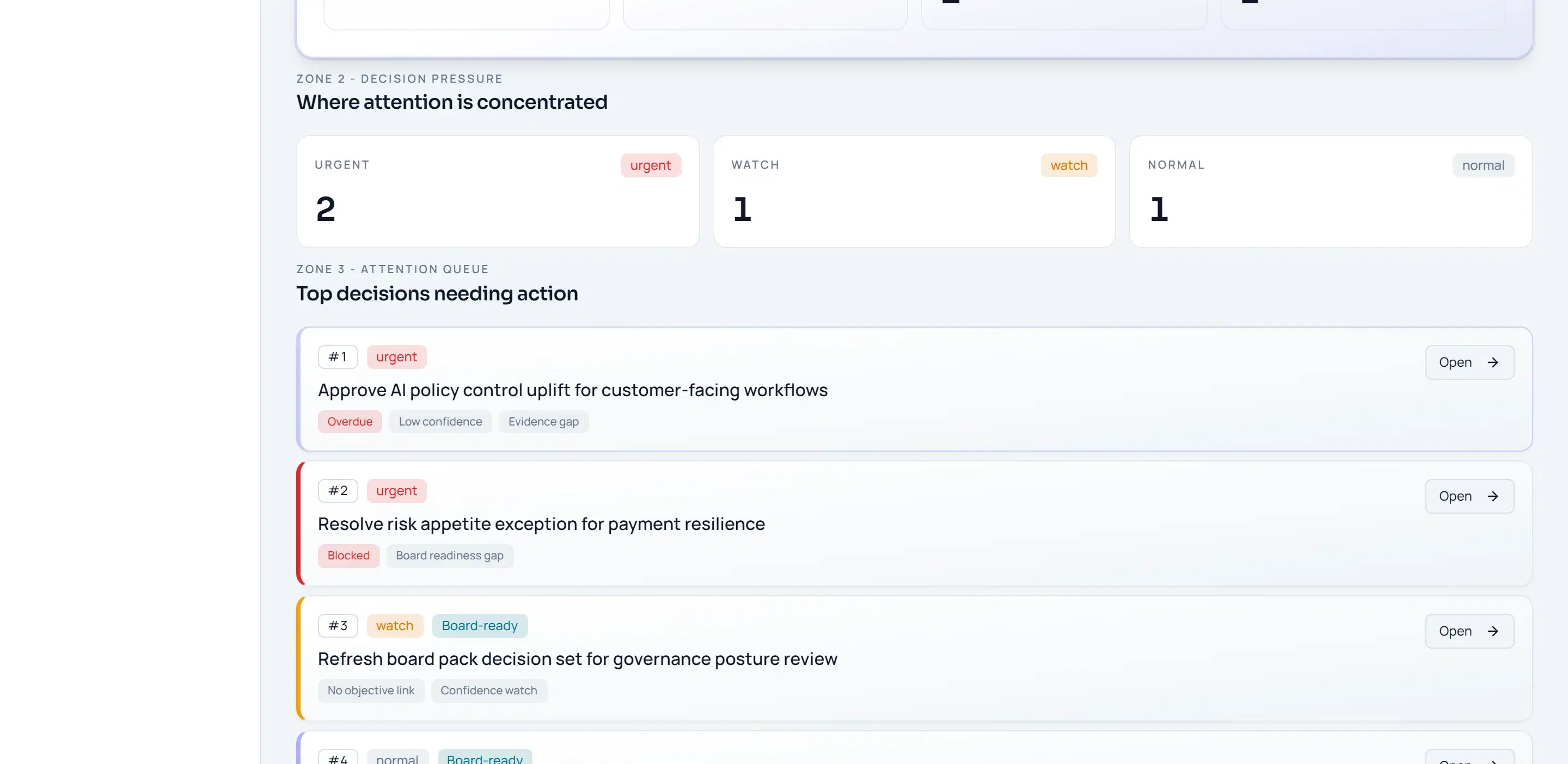
Standards enforcement cadence
Committee attention
Member monitoring remediation
Open
Audit finding escalation acceptance
Resolved
Board readiness summary
Evidence
Evidence lineage established — board narrative can cite source artefacts.
- Committees are asked to approve, challenge, and record judgement — often on incomplete narrative assembled outside the system of record. Decision readiness means the board sees unresolved pressure, formal decisions, and evidence links before the meeting — not during it.
- A board pack that claims assurance without evidence links is a liability. Board Book sections inherit from governed objects with evidence attached — so directors can challenge with specificity.
- Regulators, auditors, and shareholders ask what the board knew and when. Decisions in email are not defensible. The Decision Register captures judgement on the record — linked to risks, controls, incidents, and committee context.
Assurance intelligence
From control assertion to audit confidence.
Organisations do not make decisions based on activity. They make decisions based on confidence.
Control → assertion → evidence → finding → remediation — one chain, visible in the graph.
Evidence
Evidence can be traced to the assertions and controls it supports.
Evidence
Source artefacts link to controls and assertions — proof attached to governed objects, not folder shares.
Evidence can be traced to the assertions and controls it supports.
Confidence indicators
- Evidence coverage91%
- Assertions with evidence links114 / 126
- Source systems connected8
Confidence is knowing which controls are proven — not which are documented.
Evidence coverage shows where assertions are supported — and where they are aspirational.
Testing cycles link to control objects; results feed assurance intelligence.
Attestations are governance signals — not annual checkbox exercises.
Audit confidence rises when internal assurance and audit intelligence share lineage.
Evidence and assurance surfaces
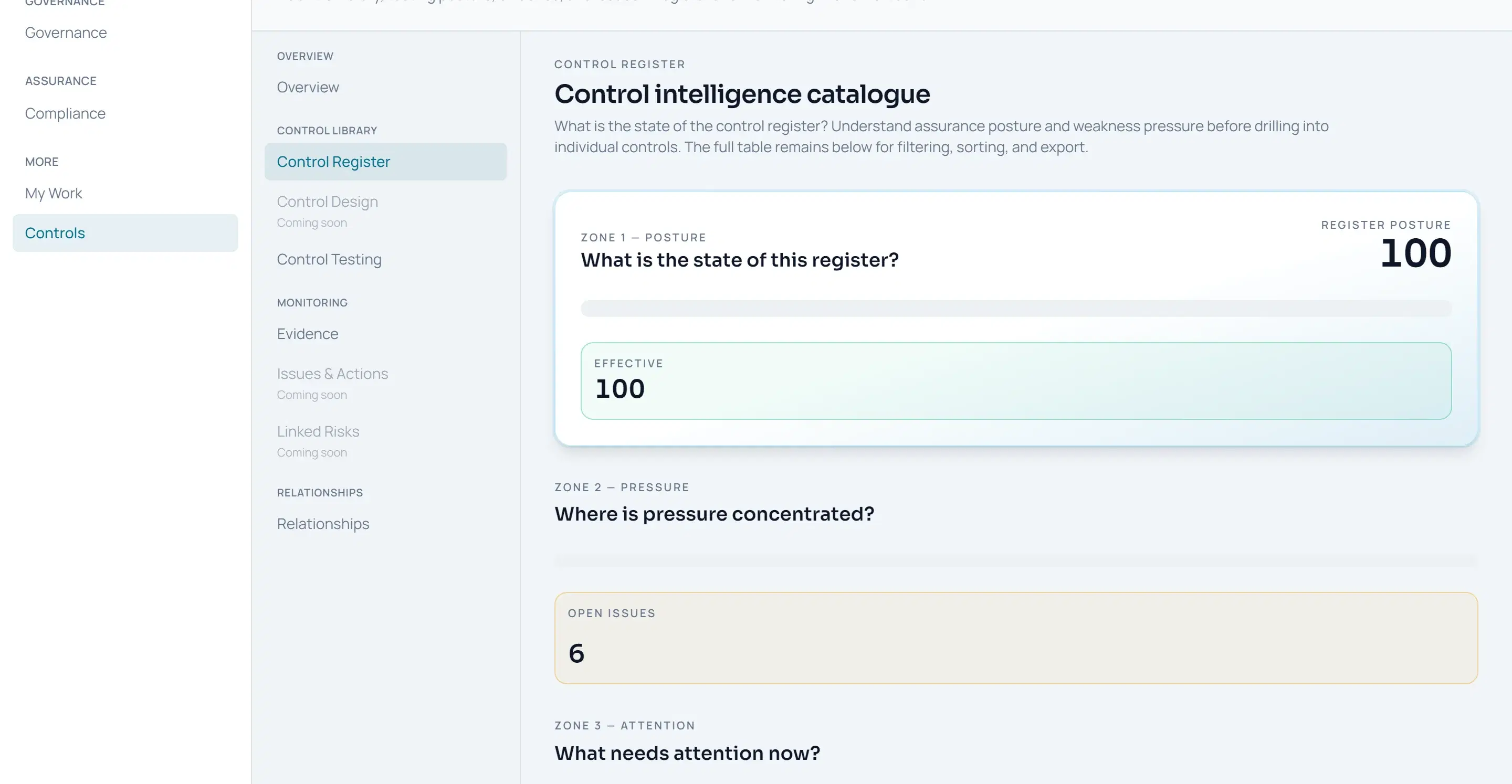
Control register intelligence
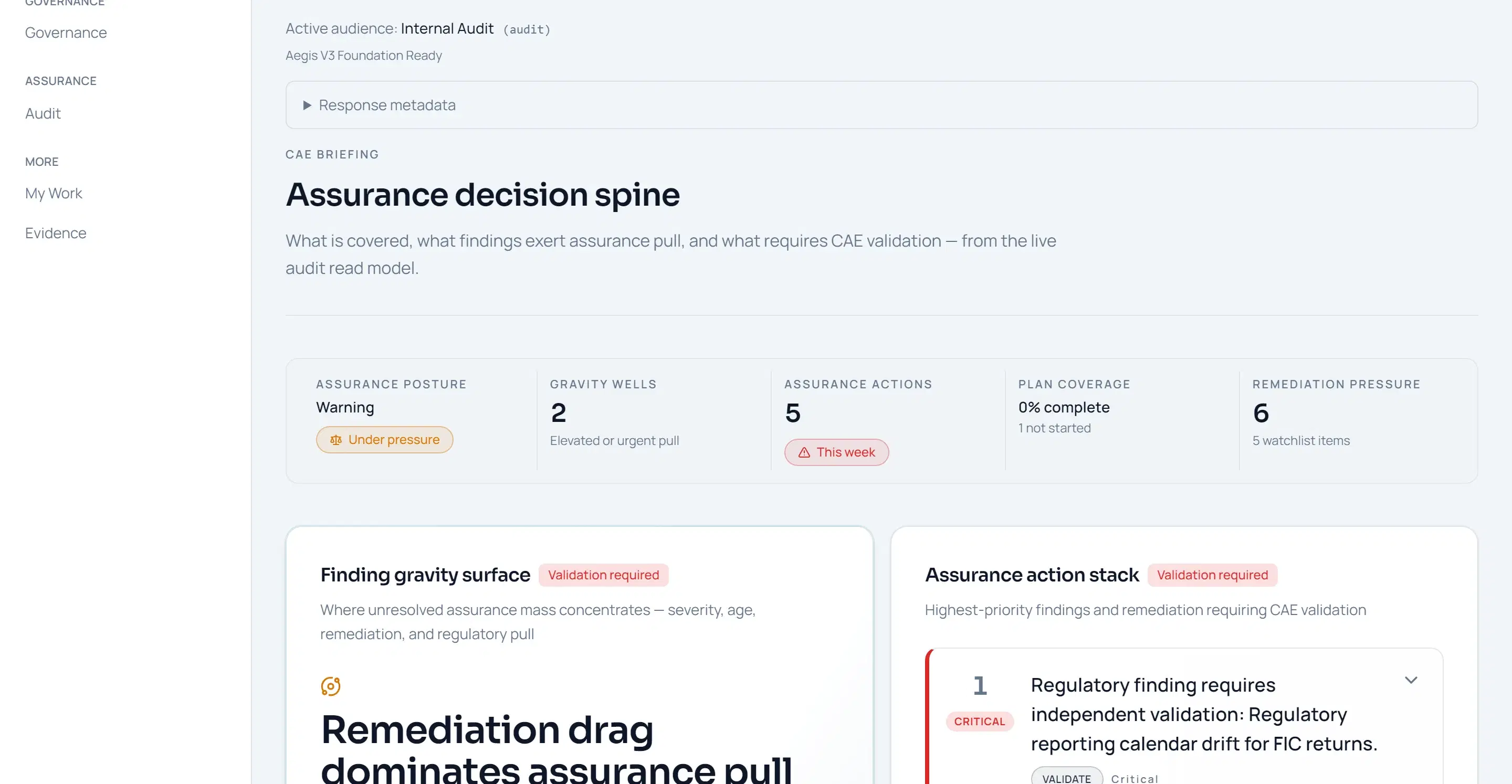
Audit command centre
Governance intelligence
Governance intelligence
Cross-domain governance intelligence for committee and executive review.
Incident intelligence
From intake to board attention — one intelligence thread.
Disruption becomes traceable, governable, and learnable.
Aegis turns incidents into governance intelligence — connected to risk exposure, control weakness, evidence, escalation, and closure readiness.
Capture the signal at source
Aegis turns incidents into governance intelligence — connected to risk exposure, control weakness, evidence, escalation, and closure readiness.
Intake
Capture the signal at source
Capture signals from operations, users, and integrated security and ITSM systems — incidents enter the governance model as governed objects, not orphaned tickets.
Governance signalOperational disruption becomes a traceable governance event.
Related governed objects
- Incidents
- ITSM signals
- Security events
Incident intelligence indicators
- Open incidents8
- Signals from integrations5
- Mean time to intake2.1 hours
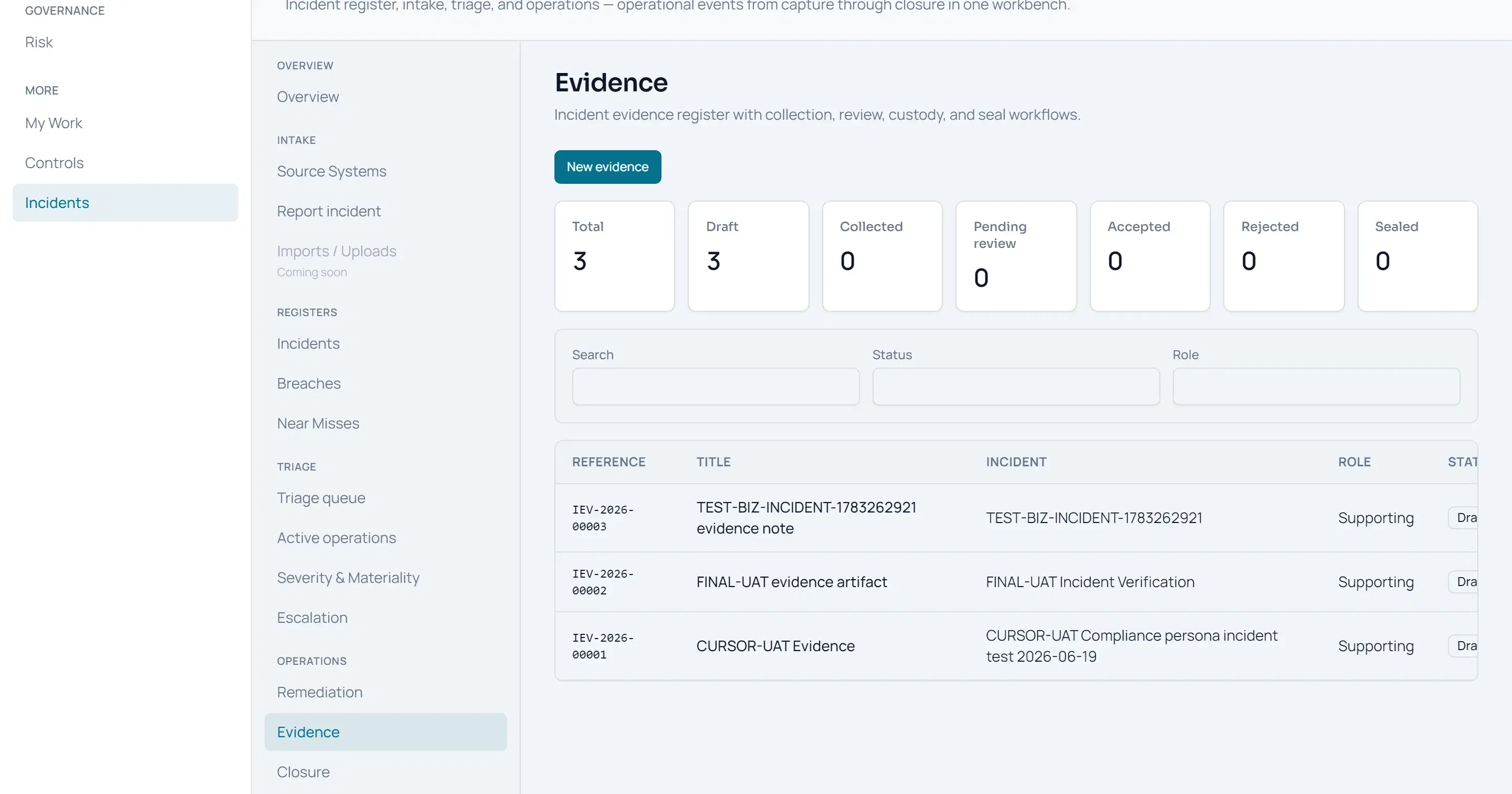
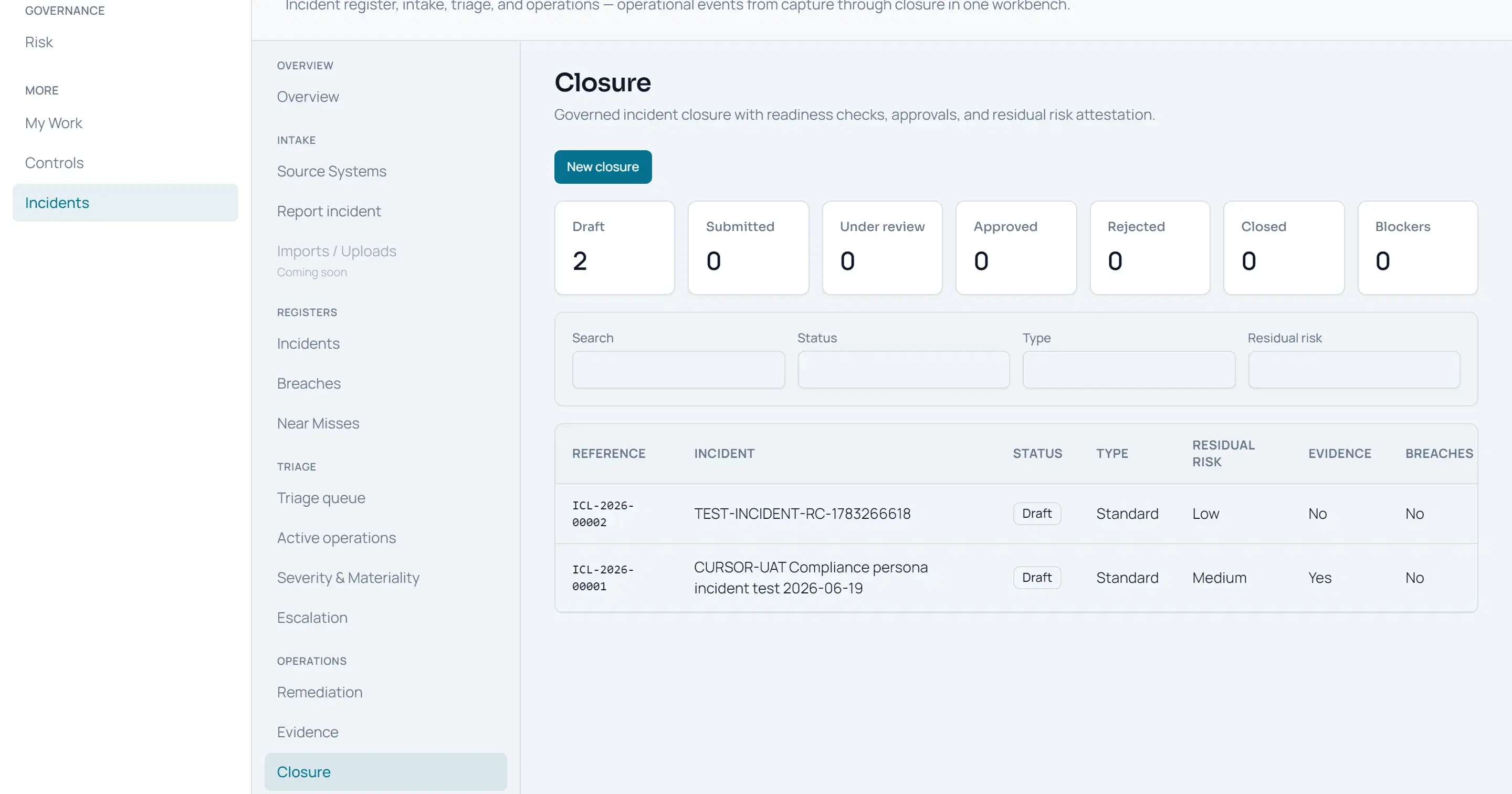
Escalation, evidence, and closure surfaces
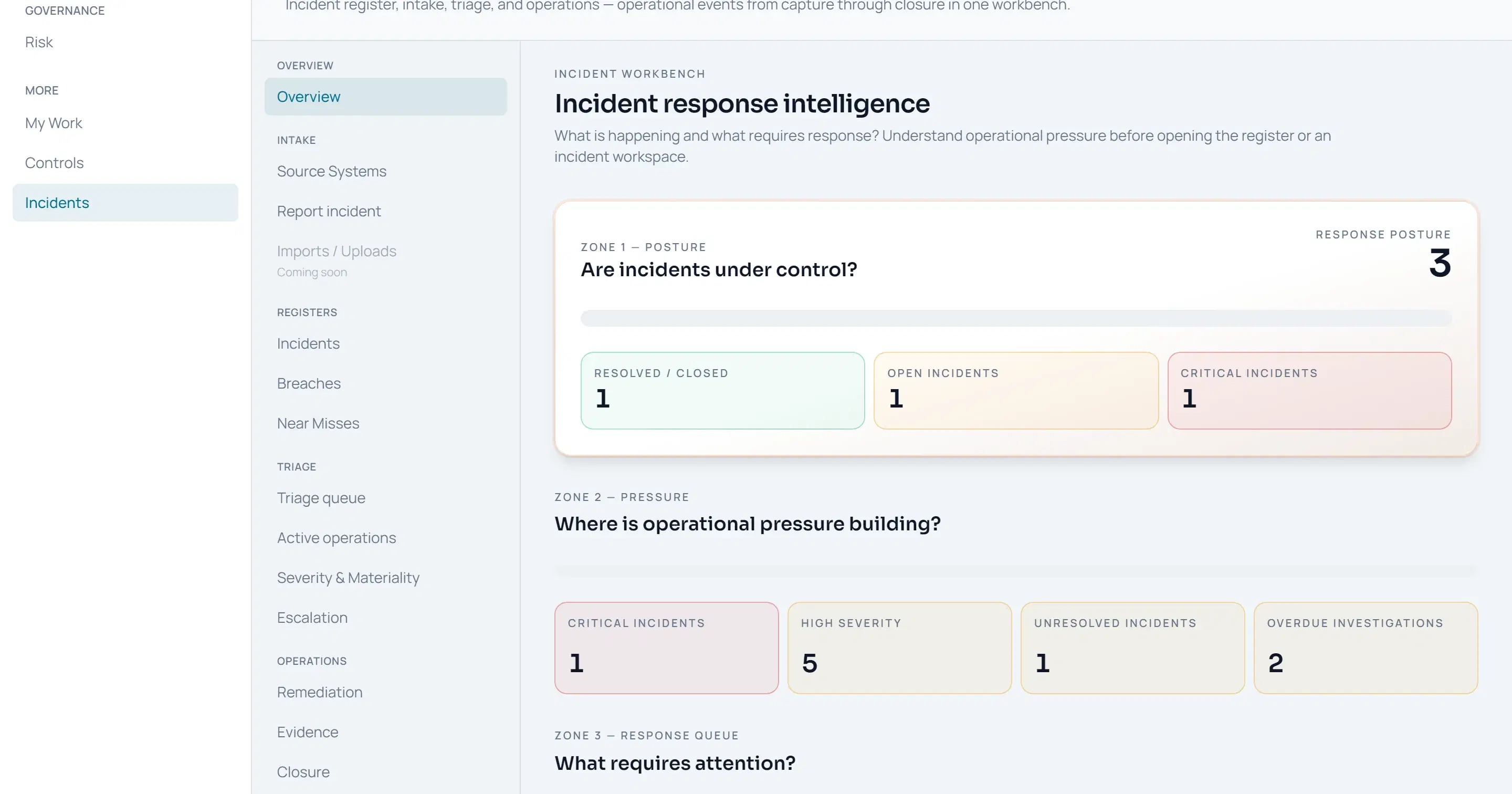
Incident workbench
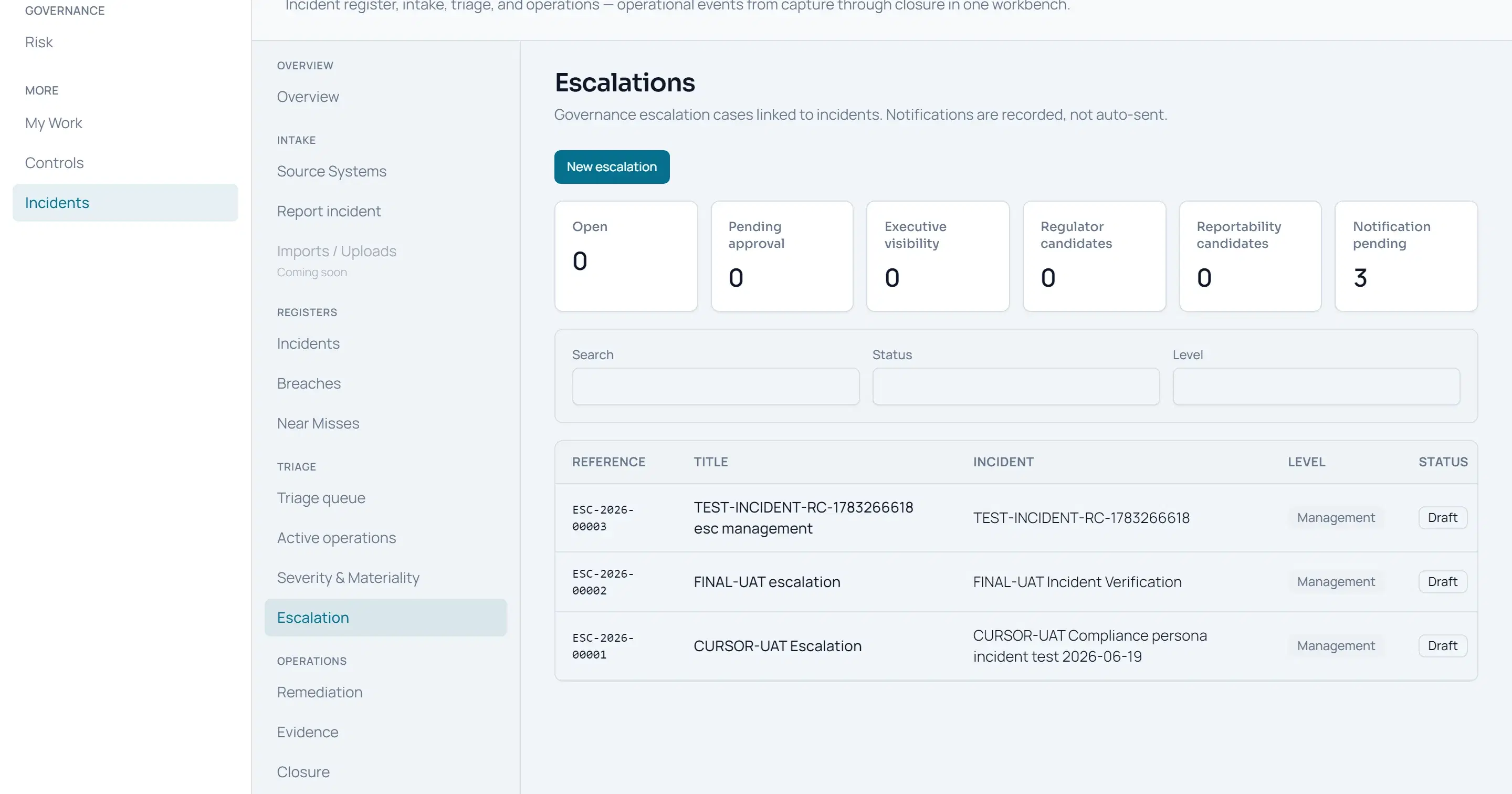
Escalation lifecycle
Evidence management
Closure readiness
Enterprise trust
ISO 27001-aligned security and governance practices.
Built for sensitive governance work — not generic cybersecurity theatre.
Aegis governance trust layer
Built for regulated environments
ISO 27001-aligned practices
Built for regulated environments
Security and governance practices aligned to ISO 27001 principles — access control, logging, secure development, and supplier risk management — for organisations where trust is contractual.
Security controls
Access control
Principle-aligned access policies for governed objects
Security logging
Operational and security events retained for review
Secure development
Change management aligned to ISO 27001 practices
Supplier risk
Third-party and cloud dependency governance
Evidence and traceability
- Access policyTraceable
ISO 27001-aligned control mapping
- Security event logTraceable
Retention and review workflow
- Change recordTraceable
Secure development lifecycle entry
FAQ
Questions leadership teams ask
Governance
What is a Governance Intelligence Platform?
A Governance Intelligence Platform connects governed registers, intelligence engines, and persona command centres into one operating model. Aegis reads risk, control, policy, obligation, incident, assertion, evidence, and decision objects — then produces signals each role can act on. It is not another register and not another dashboard.
How is Aegis different from traditional GRC software?
Traditional GRC tools stop at registers and static dashboards. Aegis adds intelligence engines, the Governance Graph for lineage, persona command centres, and committee outputs such as Board Book and Decision Register — so leadership sees pressure, confidence, and unresolved judgement on one model.
Adoption
Can we start with Excel registers?
Yes. Upload your workbook, map columns to governed fields, validate lineage, and activate registers inside Aegis. Your first persona command centre can open on live imported data without a multi-year implementation programme.
How long does implementation take?
Organisations typically reach first intelligence in weeks — upload, map, validate, and open a command centre — rather than months of disconnected implementation. Scope varies by register complexity and integration depth.
Do we need to replace our existing systems?
No. Aegis integrates with identity, ITSM, ERP, HR, productivity, and data platforms. Existing systems remain the system of record; Aegis becomes the governance intelligence layer above them, with integrations attached as edges in the Governance Graph.
Security
Is Aegis ISO 27001 aligned?
Aegis is built with ISO 27001-aligned security and governance practices for regulated environments — appropriate for sensitive risk posture, committee decisions, and evidence artefacts.
How does Aegis handle access control?
Enterprise authentication, role-based access, and persona-scoped command centres ensure each user sees intelligence aligned to their accountability — not a single undifferentiated dashboard.
Leadership
Who uses Aegis?
Board members, executives, CROs, compliance leaders, internal audit, and department leadership — each through a persona command centre tuned to what that role must defend or decide.
What is the Governance Graph?
The Governance Graph links policy, control, risk, obligation, evidence, incident, assertion, and decision objects. Trace lineage without rebuilding the story in slides — see how pressure propagates and where committee confidence is supported by proof.
What are Intelligence Engines?
Six engines read governed registers and produce persona-ready intelligence — governance health, risk pressure, compliance confidence, assurance gaps, audit signals, and incident escalation patterns — on the same object model.
Ready to see it in context? Request a guided demo.
Ready when you are
See your governance model as intelligence.
Move from disconnected registers to evidence-linked governance intelligence.
Schedule a guided demo tailored to your operating model, framework posture, and committee calendar.
Evidence-linked governance intelligence